
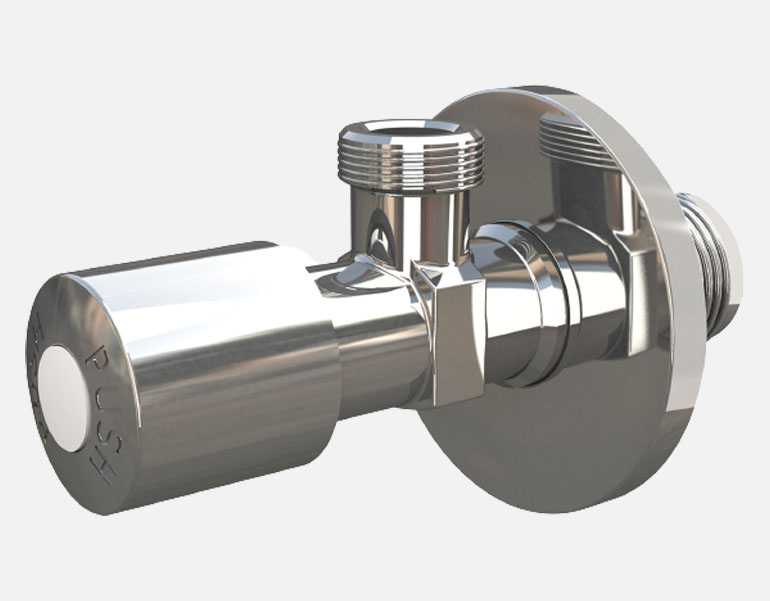
Angle Valves
A globe valve design in which the inlet and outlet ports are perpendicular to each other. It uses a linear motion to move a closure member into and out of a seating surface. Angle valves are commonly used in boiler feedwater and heater drain service and in piping schemes where space is at a premium and the valve can also serve as an elbow. The valve can have cage-style construction or expanded outlet connections, restricted trim, or outlet liners for reduction of erosion, flashing, or cavitation damage.
Angle valves are structured so that the center lines of the entrance and exit of the fluid intersect perpendicularly. In general, the horizontal line is the entrance and the vertical line is the exit.
This structure allows the fluids commonly known as slurry (i.e. viscous fluids and fluids including solid bodies) to pass more easily through the valve, making it suitable for controlling them. Additionally, it prevents the valve from being damaged due to fluid cavitation and flashing, making it suitable for fluids with these conditions.