
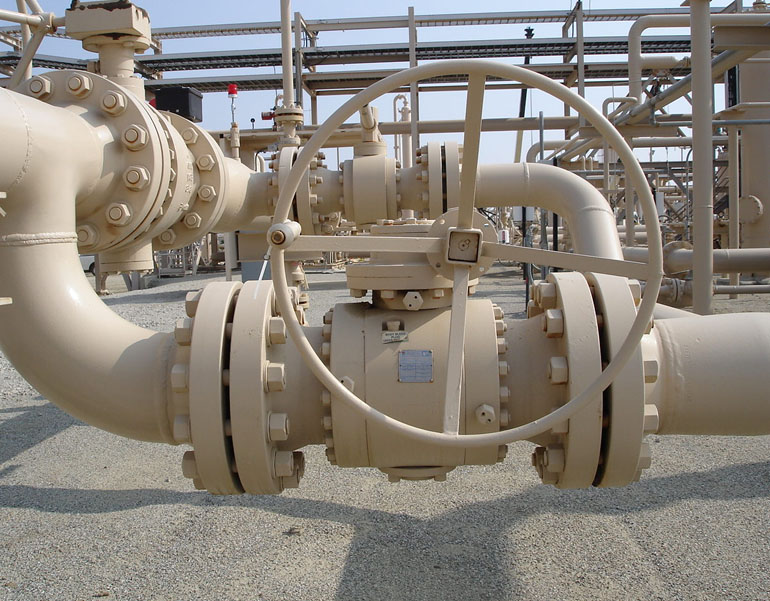
Ball Valves
A ball valve is a shut off valve that controls the flow of a liquid or gas by means of a rotary ball having a bore. By rotating the ball a quarter turn (90 degrees) around its axis, the medium can flow through or is blocked. They are characterized by a long service life and provide a reliable sealing over the life span, even when the valve is not in use for a long time. As a result, they are more popular as a shut off valve then for example the gate valve.
The most common design is the "floating ball design". The ball is suspended in the media and held in place by two sealing rings. Some high-quality valves have a trunnion ball design. The ball is supported at the top and bottom to reduce the load on the valve seats.
The handle is connected to the valve stem (Figure 2 number 1) and is capable of turning the valve from the open or closed position (90 degrees). If installed correctly, the valve will be open when the handle is parallel to pipe and closed when the handle is perpendicular to the pipe. Taking note of the handle direction is important to visually know if the valve is open or closed. There are additional ball valve handle types, like lockable handles or ball valve handwheels. These operate as their names suggest. If you have a bigger ball valve or need additional torque to open or close the valve, a ball valve handle extension may be required. If your handle breaks, is miss-placed or you are converting an automatic ball valve to a manual one, you can buy ball valve handle replacements.