
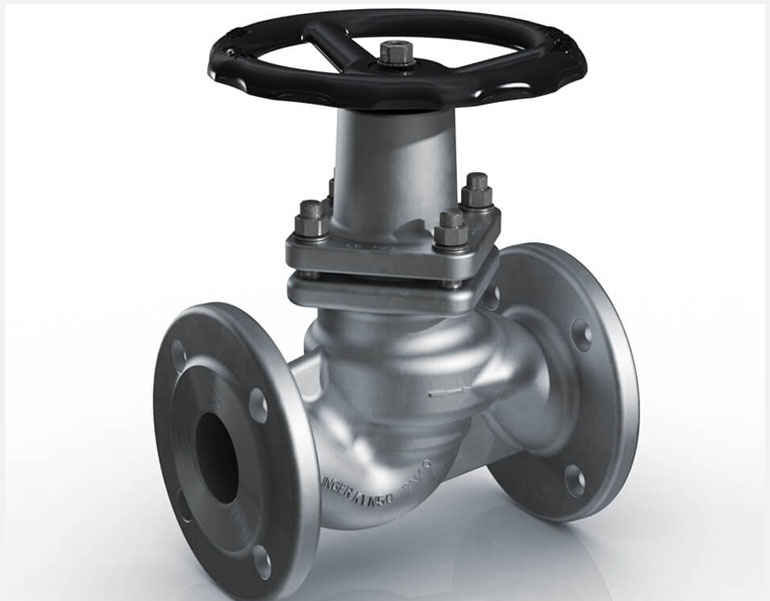
Piston Valves
A piston valve is a device that is used to control the motion of a fluid along a tube or pipe by means of the linear motion of a piston within a chamber or cylinder. Piston valves are used for fully open or fully closed for on/off regulation on steam, gas, and other fluid services. These valves are mostly used on fluids that cause excessive seat wear. Piston valves are mostly actuated manually, but sometimes other actuation modes such as hydraulic and electric are used. Piston valves are usually used where the valve body is permanently installed to reduce maintenance. Piston valves are not designed for throttling applications and they must be used in fully opened or closed positions. When the valve is fully opened, only the bottom face of the piston is exposed to fluid and the rest of the body is protected by the upper sealing rings. So the sealing surfaces are protected from erosion by the fluid flow.
The construction of a piston valve is similar to a globe valve and they are used to shut off and regulate. These valves provide positive shut-off. The shut-off assembly comprises the metal piston, two resilient valve rings, and a metal lantern bush. The sealing surface consists of the outer vertical surface of the piston and the corresponding inner surfaces of the sealing rings. This provides a sealing surface compared to the globe valves of conventional design. At the beginning of the opening, a displacement uncovers the small flow section. Which controls the low rate of flow.